Exhibition Notice
 Booth No.: To Be Advised
Date:November 10 – November 13, 2026
Venue: Messe Munich
Location: Germany, Munich
Industry: Electric & Electronics

Automotive Grade Tantalum Capacitors
Polymer Tantalum Capacitors
Dipped, SMD, Low ESR Tantalum Capacitor
Equivalence to AVX, Kemet, Vishay


Booth No.: To Be Advised
Date:November 10 – November 13, 2026
Venue: Messe Munich
Location: Germany, Munich
Industry: Electric & Electronics
What is an Electrolytic Capacitor?
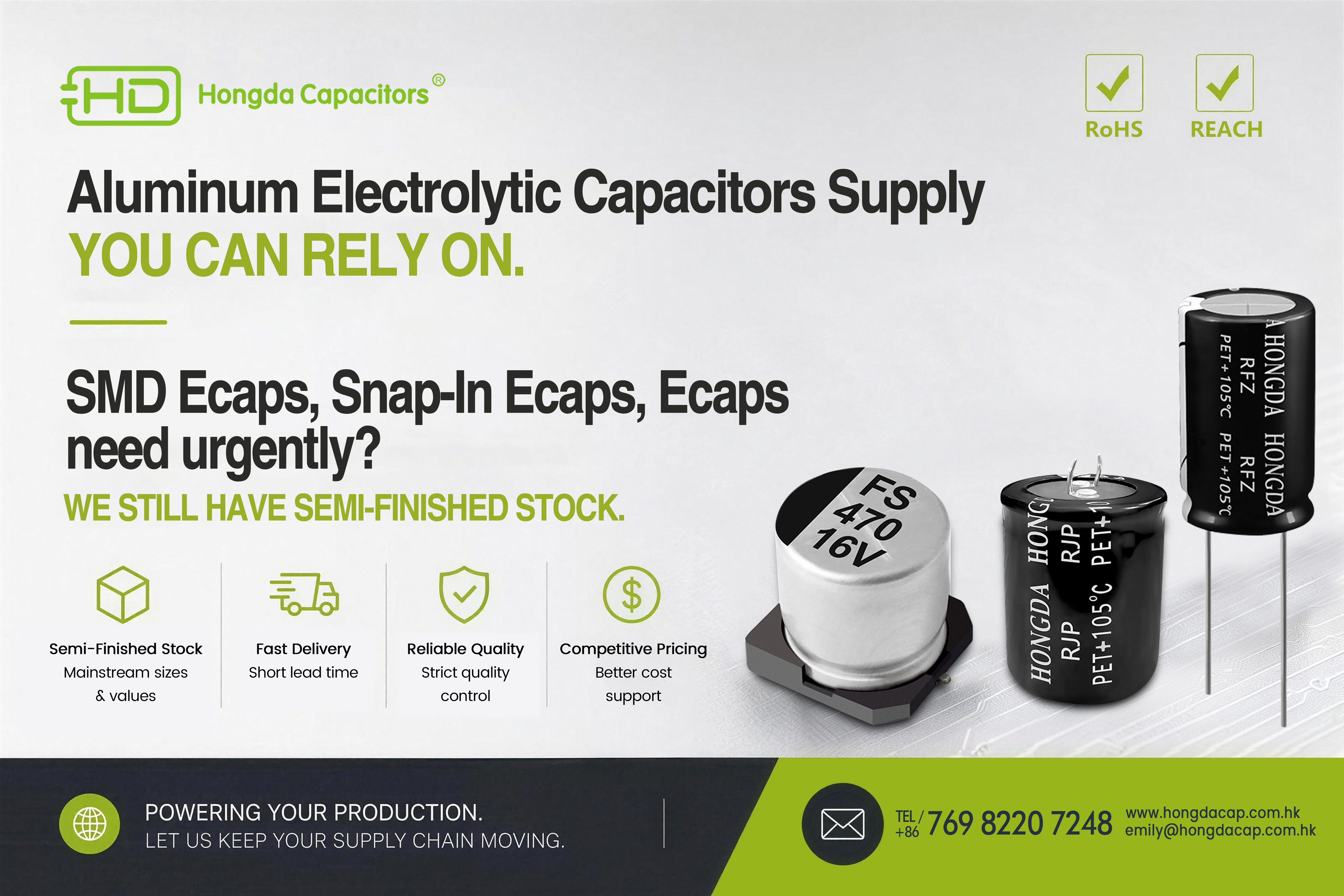
Electrolytic Capacitors Electrolytic capacitors are a type of capacitor that uses an electrolyte to achieve greater capacitance than other capacitor types. The electrolyte is a liquid or gel containing a high concentration of ions. Almost all electrolytic capacitors are polarized, which means that the voltage on the positive electrode must always be greater than the voltage on the negative electrode. The benefits of large capacitance in electrolytic capacitors also come with several disadvantages. These disadvantages include large leakage currents, value tolerances, equivalent series resistance, and limited lifespan. Electrolytic capacitors can be either wet electrolyte or solid polymer. They are typically made of tantalum or aluminum, but other materials can also be used. Supercapacitors are a special subtype of electrolytic capacitors, also called double-layer electrolytic capacitors, with capacitances of hundreds and thousands of farads. This article will be based on aluminum electrolytic capacitors. Their typical capacitance ranges from 1μF to 47mF, and their operating voltage can be up to several hundred volts DC. Aluminum electrolytic capacitors are found in many applications, such as power supplies, computer motherboards, and many home appliances. Because they are polarized, they may only be used in DC circuits. Computer motherboards and many home appliances. Because they are polarized, they may only be used in DC circuits. Computer motherboards and many home appliances. Since they are polarized, they may only be used in DC circuits.
Definition of Electrolytic Capacitors
An electrolytic capacitor is a polarized capacitor that uses an electrolyte to achieve greater capacitance than other capacitor types.
Reading Capacitance Values
For through-hole capacitors, the capacitance value is printed on the case along with the maximum voltage rating. A capacitor printed with "4.7μF 25V" has a nominal capacitance value of 4.7μF and a maximum voltage rating of 25 volts, which must never be exceeded.
For SMD (surface mount) electrolytic capacitors, there are two basic types of markings. The first clearly states the value in microfarads and the operating voltage. For example, using this method, a 4.7μF capacitor with an operating voltage of 25 volts would be marked "4.7 25V". In the other marking system, a letter is followed by three numbers. The letter indicates the rated voltage according to the table below. The first two numbers indicate the value in picofarads, while the third number is the number of zeros to be added to the first two.
Features
Capacitance Drift
Over time, the capacitance of electrolytic capacitors drifts from the nominal value, and they have a large tolerance, typically 20%. This means that an aluminum electrolytic capacitor with a nominal capacitance of 47μF is expected to measure between 37.6μF and 56.4μF. Tantalum electrolytic capacitors can be manufactured to tighter tolerances, but they have lower maximum operating voltages, so they cannot always be used as a direct replacement.
Polarity and Safety
Due to their construction and the properties of the electrolyte used, electrolytic capacitors must be forward biased. This means that the positive terminal must always be at a higher voltage than the negative terminal. If the capacitor is reverse biased (if the voltage polarity across the terminals is reversed), the insulating aluminum oxide that acts as a dielectric can become damaged and begin to act as a short circuit between the two capacitor terminals. This can cause the capacitor to overheat due to the large current flowing through it. When the capacitor overheats, the electrolyte can heat up and leak out or even evaporate, causing the case to rupture. This process occurs at reverse voltages of about 1 volt and above. To maintain safety and prevent the case from exploding due to the high voltages generated in overheating conditions, a safety valve is installed in the case. This is usually made by making a score in the upper surface of the capacitor that opens in a controlled manner when the capacitor overheats. Because the electrolyte can be toxic or corrosive, you may need to take extra safety measures when cleaning after replacing an overheated electrolytic capacitor.
AC has a special type of electrolytic capacitor that can withstand reverse polarization. This type is called non-polarized or NP type.
Construction and Performance of Electrolytic Capacitors
Aluminum electrolytic capacitors are made of two aluminum foils and a paper spacer soaked in electrolyte. One of the two aluminum foils is covered with an oxide layer, and this foil serves as the anode, while the uncoated foil serves as the cathode. During normal operation, the anode must be at a positive voltage relative to the cathode, which is why the cathode is most often marked with a negative sign along the body of the capacitor. The anode, electrolyte-soaked paper, and cathode are stacked together. The stack is rolled up, placed in a cylindrical housing, and connected to the circuit using pins. There are two common geometries: axial and radial. Axial capacitors have a pin at each end of the cylinder, while in radial geometry, both pins are located at the same end of the cylinder.
The capacitance of electrolytic capacitors is greater than most other capacitor types, typically ranging from 1μF to 47mF. There is a special type of electrolytic capacitor, called a double layer capacitor or supercapacitor, which can have a capacitance of up to several thousand farads. The capacitance of an aluminum electrolytic capacitor is determined by several factors, such as the plate area and the thickness of the electrolyte. This means that large capacitors are bulky and large in size.
It is worth mentioning that electrolytic capacitors made using older technology do not have a long shelf life, usually only a few months. If not used, the oxide layer deteriorates and must be rebuilt in a process called capacitor reforming. This can be performed by connecting the capacitor to a voltage source through a resistor and slowly increasing the voltage until the oxide layer is completely rebuilt. Modern electrolytic capacitors have a shelf life of 2 years or more. If the capacitor remains unpolarized for a long time, it must be reformed before use.
Suitable for electrolytic capacitors
There are many applications that do not require tight tolerances and AC polarization, but require large capacitance values. They are often used as filtering devices in various power supplies to reduce voltage ripple. When used in switching power supplies, they are often the key component that limits the life of the power supply, so high-quality capacitors are used in this application.
If the signal is a DC signal with a weak AC component, they can also be used for input and output smoothing as low-pass filters. However, electrolytic capacitors do not work well for large amplitude and high frequency signals due to the power dissipated at the parasitic internal resistance called equivalent series resistance (ESR). In such applications, low ESR capacitors must be used to reduce losses and avoid overheating.
A practical example is the use of electrolytic capacitors as filters in audio amplifiers, where the main purpose is to reduce mains hum. Mains hum is a 50Hz or 60Hz electrical noise caused by the mains supply that can be heard if amplified.